Four ways to use and maintain your access to land
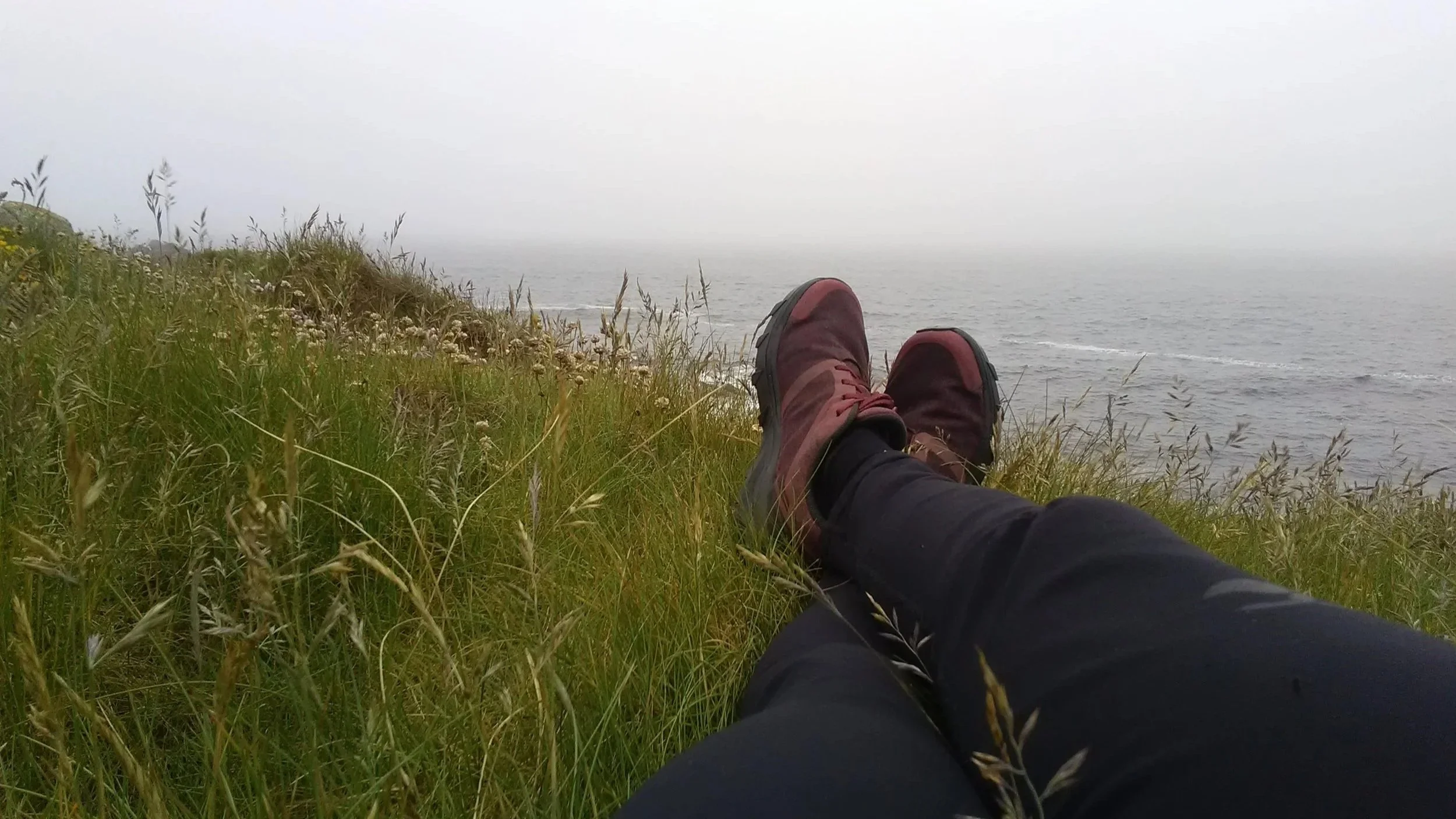
Somewhere on the Isles of Scilly
We are constantly pressed to care for and protect ‘our planet’, yet only 8% of land in England is open-access land, where the general public is allowed to roam freely. How is that compatible?
Here, I argue that using our planet to the legal limits and beyond is fundamental to maintaining a link with the environment, without which it is hard to care for the future of our ecosystem.
I also propose a few simple (and legal) ways to maintain and increase our access rights.
Why harmlessly using the planet makes us care
In England and many other countries, access to the outdoors is very limited and depends on socio-economic conditions. Even for more privileged people, seeing nature in the form of a shrine-like manicured National Trust garden or private fields makes it difficult to connect with it. Inability to connect with nature, in turn, makes it difficult to care for the environment when we don’t live in a country that experiences unbearable temperatures or large natural disasters (yet).
Have you ever been on a trek or a bikepacking journey, relying on rivers for drinking water? Have you ever felt your heart sink when you reached a dry river bed where the map indicated water? This is becoming more and more common, and is set to get worse. No need to go to another continent to see it. I experienced it in Spain.
Adopting nomadic ways didn’t just get me thinking about the climate emergency, it made me feel it. I once pitched my tent over slushy mud in an irrigated orange field. That same day, a lady told me about the old days, when she could reliably find water in the Viar river, absent from the town of Monesterio that day.
Restricted access to bodies of water have also created a feedback mechanism that ostracises us from rivers and lakes. Imagine if most English bodies of water were regularly used by swimmers: how much more difficult would it be for waste to go unnoticed, how much more public scrutiny would water cleanliness get? Instead, we don’t swim because the water is dirty or simply forbidden, so we don’t notice as readily when the water quality changes. Water analysis is one thing. Public awareness and tangible experiences are another. The sewage map paints a shitty picture of English waterways, literally.
A quick history of public access land
The planet is ours collectively when we are asked to take action and change our habits, but not when we want to go on a walk. Has it always been this way?
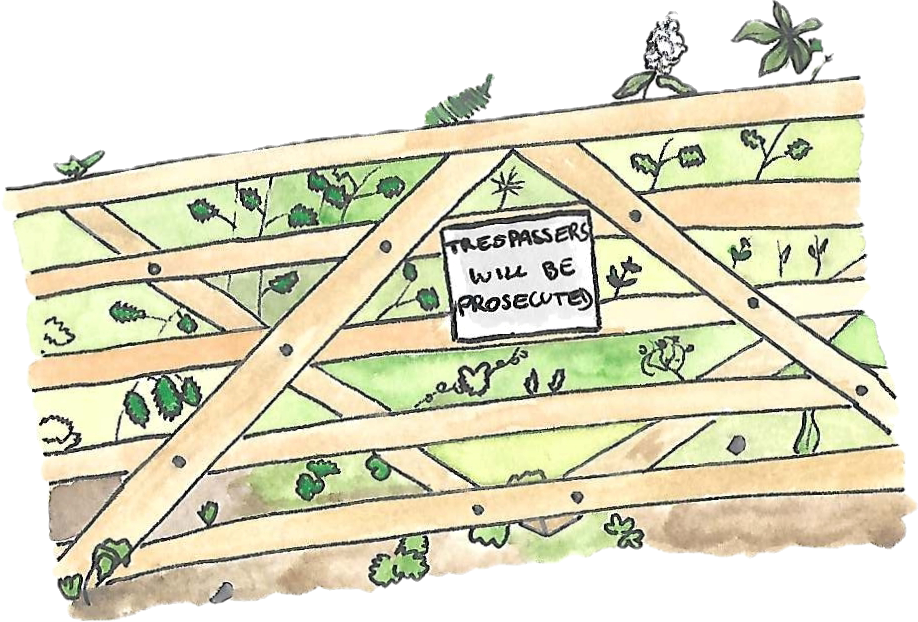
© Emma Karslake, 2025
In England, landowners started enclosing land from the thirteenth century, eating away at customary rights that the general population had to use local land, allowing them to extract peat, keep animals and collect wood. This led to tensions between landowners and the general public throughout the following centuries, with many events of collective action, a most famous example being the 1932 Kinder Scout Trespass, a mass trespass considered to be a key event in the creation of the Peak District National Park.
Public pushback against enclosures and in favour of the right to roam had become stronger from the 19th C, although the point was always one of contention, and new enclosures still occur: this November, a new enclosure appeared on a Sandbanks beach and angered locals.
“The law locks up the man or woman
Who steals the goose from off the common
But leaves the greater villain loose
Who steals the common from the goose”
-Anonymous English poem, 18th C
To enable ourselves to care, we need to be able to connect to our planet. Many rights are obtained or kept by acting illegally and people who were once convicted criminals go down in history as heroes, the 1932 Kinder Scout Trespass being a good example. But there are also legal ways to use, assert, and extend our current rights to reclaim ‘our’ planet.
Walk with intent
Using rights of way ensures that they remain open to the public. Beyond walking on paths, you can also contribute to formalising existing rights of way through the Ramblers’ ‘Don’t lose your way’ campaign, inviting you to search for existing public paths and legally record them so that they cannot be privatised or built over. Once a public path is officially recorded, the local authority is responsible for maintaining it and keeping it free of obstacles, such as newly installed gates. Unrecorded paths are also vulnerable to development.
In fact, you don’t even have to walk. You can join the Ramblers’ team of volunteers to help register paths from your computer.
Wild camp
Wild camping laws are, well, pretty wild across the globe and blanket bans on wild camping over a whole country are very rare. Scotland and Scandinavian countries authorise wild camping on private land; Czechia allows people to spend one night in a given place as long as they don’t pitch a tent; England forbids it with the notable exception of Dartmoor National Park. In practice, there are grey areas or areas of tolerance in every country that allow people to carry out a simple ancestral activity: sleeping outside.
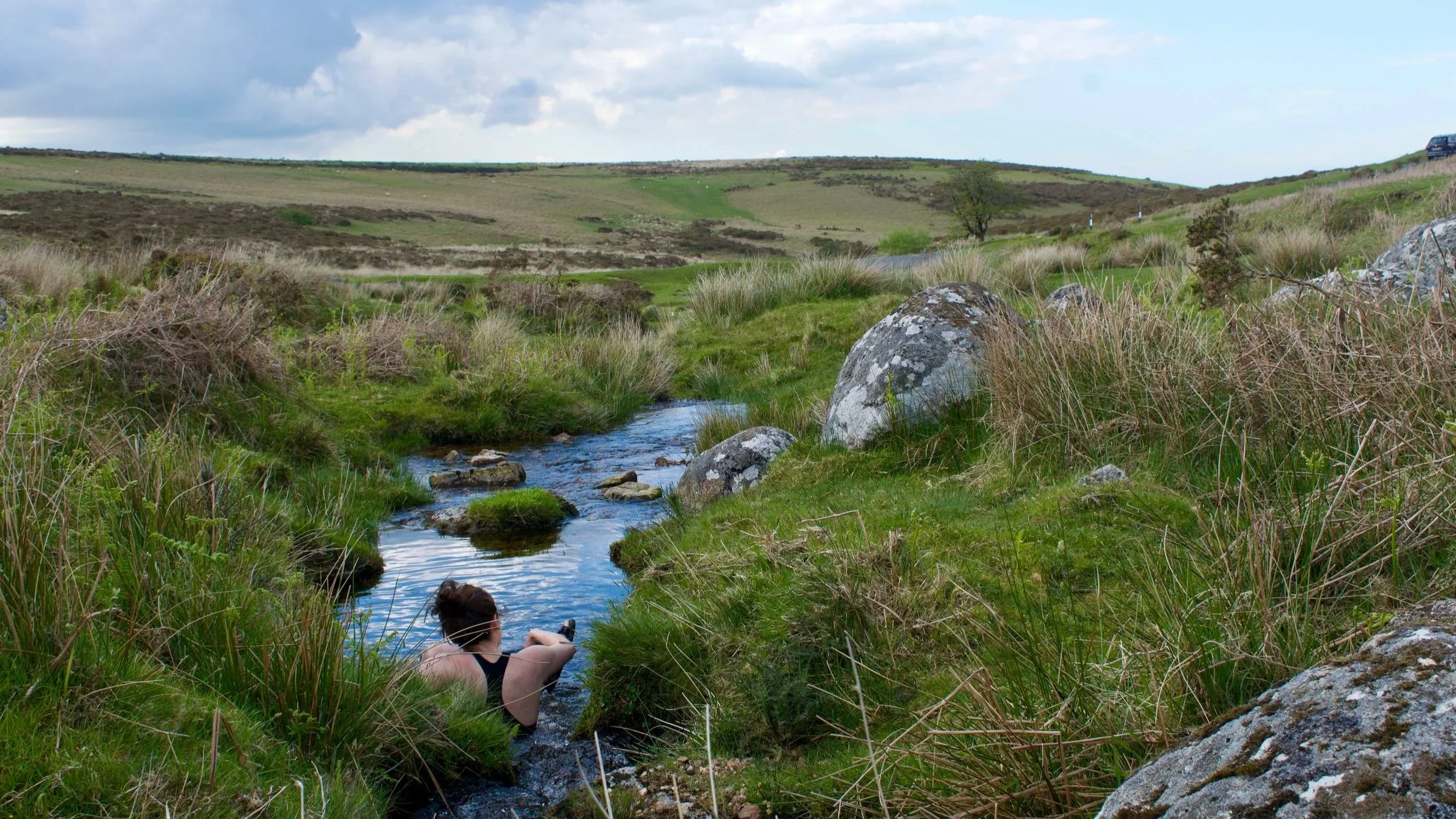
A Dartmoor dip
For example, the Lake District National Park explains that wild camping is tolerated under certain conditions. Most national parks even have guidelines for wild camping.
These rights and areas of tolerance are constantly under threat, as exemplified by the Darwall family’s recent attempt at exempting their 4,000-acre Dartmoor estate from the local right to roam.
It is important to keep in mind that camping has been a way of life for much of human history, and still is for some societies. When we campaign to retain these rights, it’s more than campaigning for what is sometimes nowadays seen and depicted as a hobby.
Ask to borrow the land
In scarcely populated areas or countries where wild camping is legal and accepted, the feeling of freedom that hiking or bikepacking gives you is enhanced by the possibility of settling down pretty much anywhere for the night. In other places, the daytime feeling of freedom and carefreeness is rudely interrupted by nightfall, reminding us that our surroundings don’t legally offer the simple option of sleeping without paying.
The solution? Asking a landowner for two square metres of grass and possibly two litres of tap water. Some will raise an eyebrow and come up with a lame excuse, the most convoluted I’ve heard being ‘If you sleep on my land and the neighbour’s cows escape and jump my gate to come and trample you, I worry that I would be legally responsible’. Alright. It’s their land after all, they can choose their guests.
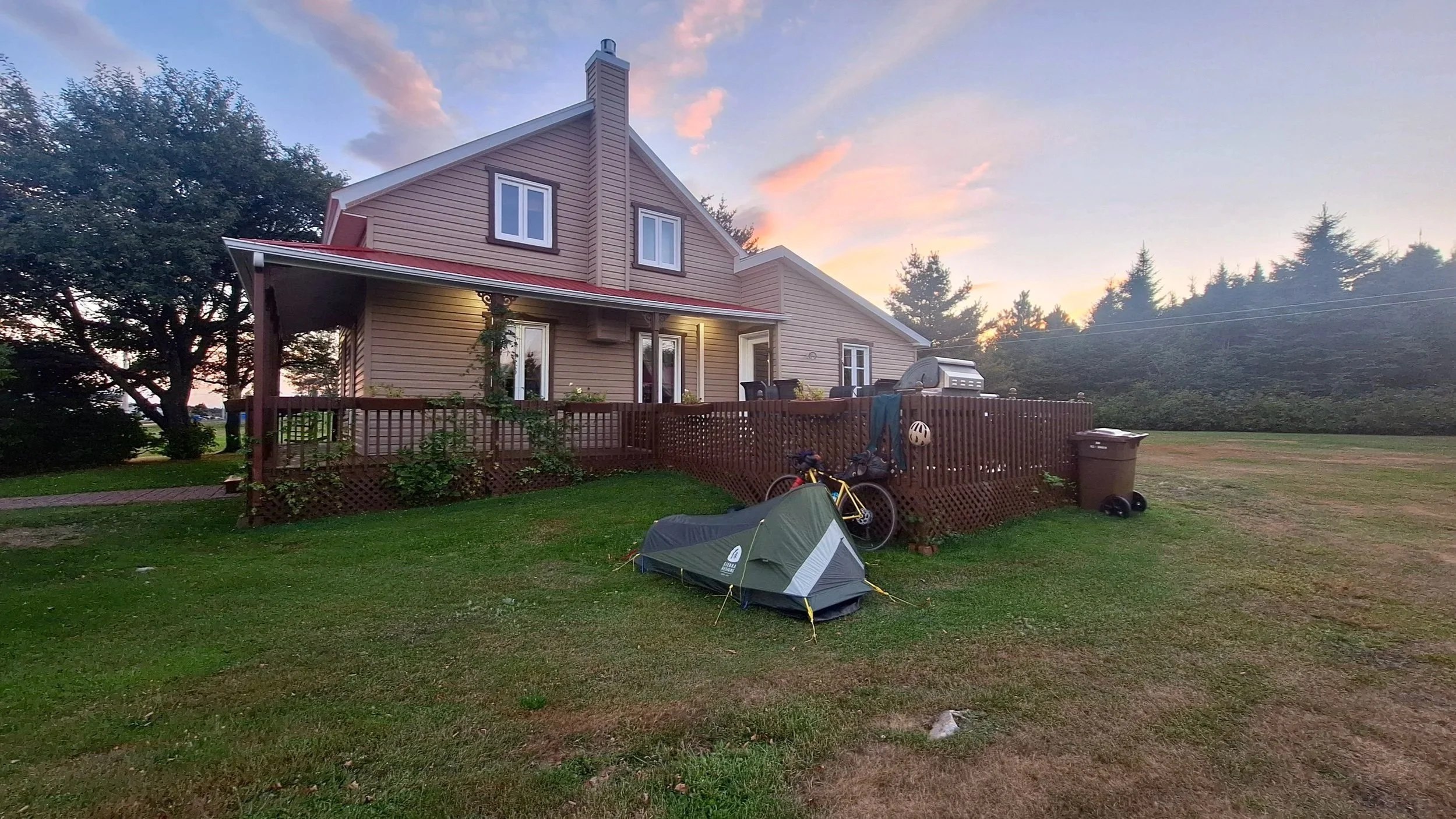
Thanks for letting me pitch, Bertrand and Andree from Quebec
However, many have said yes to me and my travelling companions, offering us a little bit of field to rest in. It occasionally leads to a cup of tea, a warm shower or even breakfast the following morning. It often leads to interesting conversations and increased knowledge of the area. Did you know that some Spanish households still have an actual fire pit under their dining table to warm their feet and legs in the absence of central heating?
More importantly, I have found that these experiences break the wall between passersby and landowners and are a wonderful way to harmlessly use our planet while making human connections.
Wild swim
In England, 97% of waterways are not accessible to the general public. That is quite a hard blow for anyone getting into kayaking or wild swimming. Once again, it’s all about embracing the grey areas.
I recently took up wild swimming, which, building on my experience as a cycling nomad, soon transformed into swim-packing, i.e. swimming along a lakeside or coast day after day, dragging my belongings in a tow float.
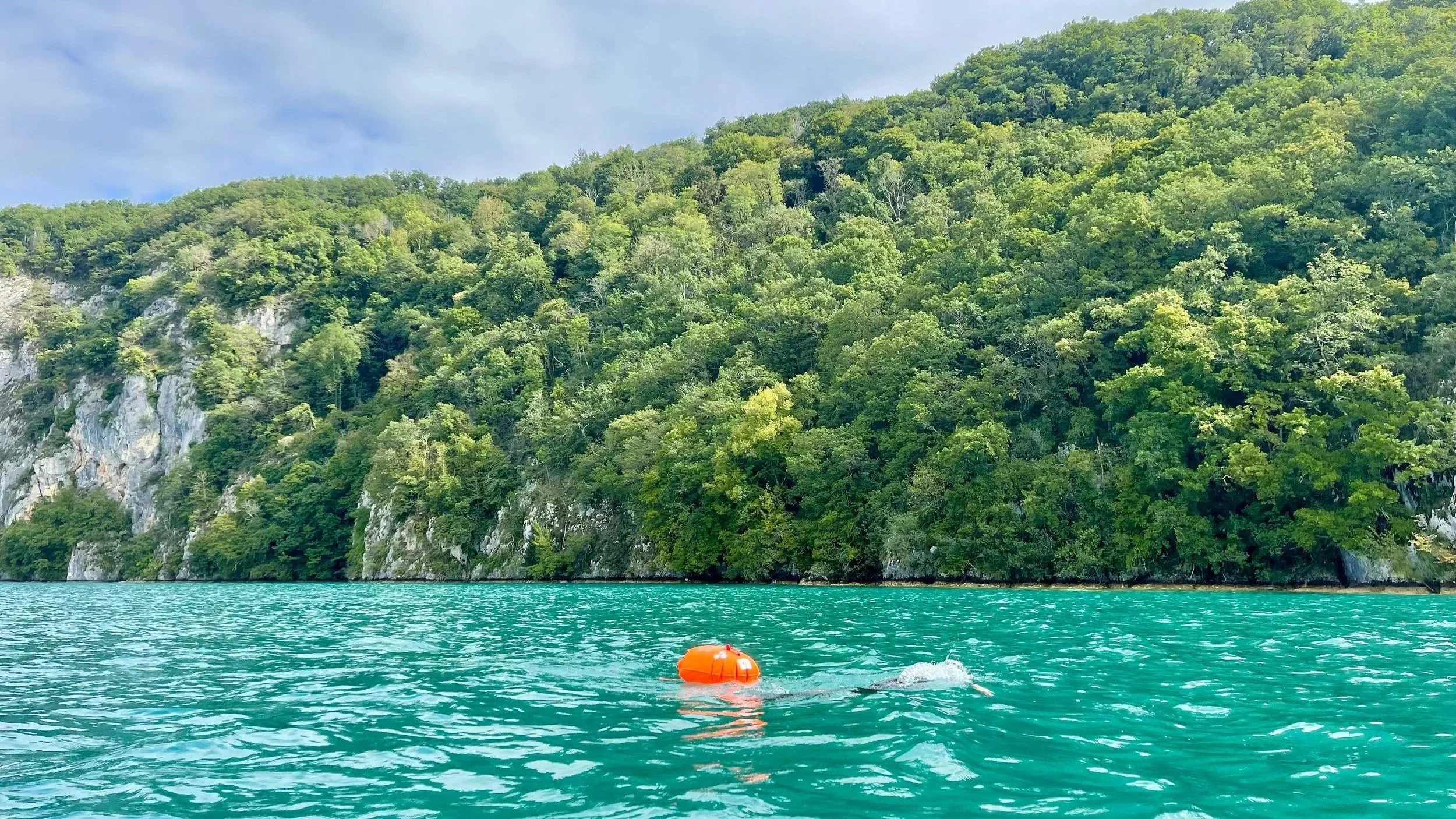
Lake Annecy
When travelling by car, by bike, or on foot, we generally know where we’re allowed to go and under what conditions; this is far from true when it comes to travelling by swimming. This is partly what attracted me to swim-touring in the first place. Bodies of water feel like a new, untamed terrain, right under our noses, a source of new adventure without flying to far-away countries.
Researching where it is legal to swim and where it is legal to get in or out of the water is an arduous task, in England as much as in many European countries. Preparing to swim the length of Lake Annecy over three days took me hours of cross-referencing maps of protected areas, ordnance surveys, private property maps and satellite imaging. This is one of the most visited lakes in Europe. So why was it so hard to identify my rights as a swimmer?
The answer appeared to be that the lake belonged to boats, jet skis, and nearby landowners. No tourist office or local club was able to tell me about rules surrounding swimming. A municipality map did explain that swimming is allowed within 100 metres of the edge, but with a long list of exceptions. I concluded that access to water by simple human means was low-down on the list of priorities. I planned as well as I could and once I was there, I went with the flow of locals, navigating which harbours were actually forbidden and which ones were swum in daily by people who knew the area.
The more we start swimming where it’s not totally forbidden and questioning why it is sometimes forbidden, the more we can start to reclaim small bits of public space. Local governments seem to arbitrarily forbid swimming in many bodies of water, which I suspect is borne out by the desire to avoid any litigation more than considering what is best for locals. The Rhine river marks the border between Germany and France: its German bank allows swimming, whereas on the French side, a few hundred metres across, it is forbidden. Both sides are equally safe, but Germans simply have a more engrained tradition of wild swimming. Let’s start questioning blanket bans, who they benefit, and how we can lift them.
Don’t take your rights or the law for granted
It is difficult to care about something you can’t see or experience, which is why public access to the planet is important for conservation and the handling of the climate crisis.
It is hypocritical to ask the general population to recycle, limit their water use, and invest in renewable energy, while making it difficult to simply roam around.
The message we get is: for the most part, you can’t walk around the country freely, and if you do want to use the land at all, for example for sleeping on, make yourself invisible or pay money.
It doesn’t have to be that way. If this is our planet, let’s use it. Walk, camp, swim. Use the rights you have, push the ones you don’t quite have yet, and keep the door open for those who follow.
